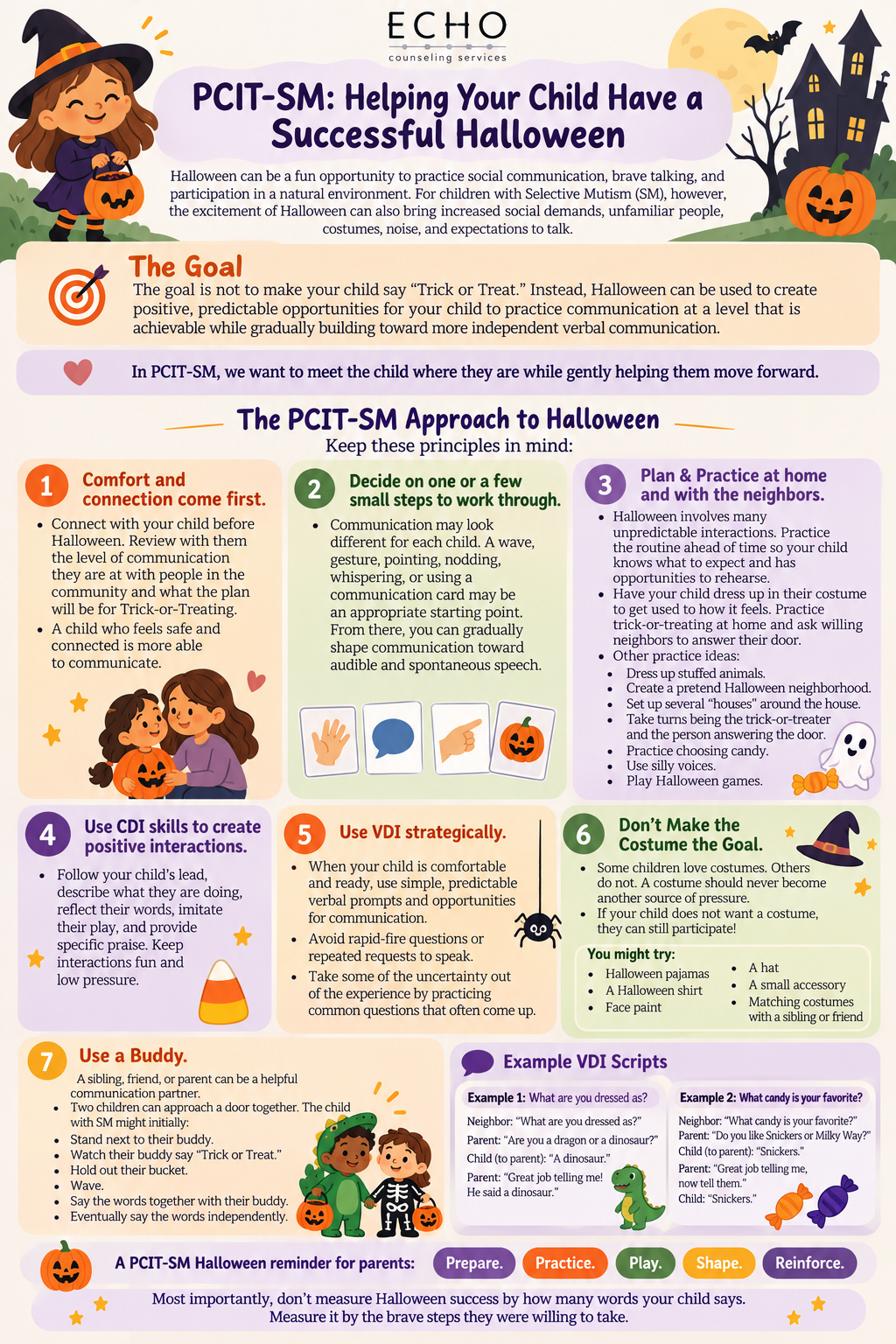
Helping Your Child Have a Successful Halloween
A practical guide to preparing for Halloween, practicing brave talking, and supporting communication without adding pressure
Halloween can be a fun opportunity to practice social communication, brave talking, and participation in a natural environment. For children with Selective Mutism (SM), however, the excitement of Halloween can also bring increased social demands, unfamiliar people, costumes, noise, and expectations to talk.
The goal is not to make your child say “Trick or Treat.” Instead, Halloween can be used to create positive, predictable opportunities for your child to practice communication at a level that is achievable while gradually building toward more independent verbal communication.
In PCIT-SM, we want to meet the child where they are while gently helping them move forward.
The PCIT-SM Approach to Halloween: Keep these principles in mind:
1. Comfort and connection come first.
Connect with your child first before Halloween. Review with them the level of communication they are at with people in the community and what the plan will be for Trick-or-Treating.
A child who feels safe and connected is more able to communicate.
2. Decide on one or a few small steps to work through.
Communication may look different from child to child. A wave, gesture, pointing, nodding, whispering, or using a communication card may be an appropriate starting point. From there, you can gradually shape communication toward audible and spontaneous speech.
3. Plan & Practice at home and with the neighbors
Halloween involves many unpredictable interactions. Practice the routine ahead of time so your child knows what to expect and has opportunities to rehearse the communication they may use.
Have your child dress up in their costume to get used to how it feels. Practice trick-or-treating routine at home with parents and siblings. Ask willing neighbors to answer their door to practice the routine.
Other practice ideas:
Dress up stuffed animals.
Create a pretend Halloween neighborhood.
Set up several "houses" around the house.
Take turns being the trick-or-treater and the person answering the door.
Practice choosing candy.
Play Halloween games.
The more predictable and enjoyable the practice becomes, the easier it may be for your child to approach the real-life experience.
4. Use CDI skills to create positive interactions.
Follow your child's lead, describe what they are doing, reflect their words, imitate their play, and provide specific praise. Keep interactions fun and low pressure.
5. Use VDI strategically.
When your child is comfortable and ready, use simple, predictable verbal prompts and opportunities for communication.
Avoid rapid-fire questions or repeated requests to speak.
Take some of the uncertainty out of the experience by practicing common questions.
Questions like what candy your child wants and what they are dressed up as come up frequently. Be ready to jump in as the intermediary to rephrase a question into something planned and predictable.
o Example: Neighbor opens the door: “What are you dressed as?”
Parent: “Are you a dragon or a dinosaur?”
Child answers parent: “A dinosaur.”
Parent: “Great job telling me! He said a dinosaur.”
o Example: Neighbor opens the door: “What candy is your favorite?”
Parent: “Do you like Snickers or Milky Way?”
Child answers parent: “Snickers.”
Parent: “Great job telling me, now tell them.”
Child: “Snickers”
6. Don't Make the Costume the Goal
Some children love Halloween costumes. Others do not. A costume should never become another source of pressure. If your child loves dressing up, wonderful! If your child does not want to wear a costume, they can still participate.
You might try:
Halloween pajamas
A Halloween shirt
Face paint
A hat
A small accessory
Matching costumes with a sibling or friend
The goal is participation and positive experiences, not a perfect Halloween costume.
7. Use a Buddy
A sibling, friend, or parent can be a helpful communication partner. For example, two children can approach a door together: The child with SM might initially:
Stand next to their buddy.
Watch their buddy say “Trick or Treat.”
Hold out their bucket.
Wave / point.
Say the words together with their buddy.
Eventually say the words independently.
This creates a natural opportunity for modeling, co-regulation, and gradual shaping of communication.
On Halloween Night
Remember that Halloween night may look different from practice. There may be:
More people
More noise
Costumes
Darker surroundings
Unfamiliar adults
Long lines
Excitement
Unexpected questions
Expect variability.
Your child may demonstrate more verbal communication at one house and less at the next. This does not mean they have "lost progress." Instead, consider the entire experience.
Look for brave participation to give Labeled Praises to:
Approaching the house
Walking up the steps
Ringing the bell
Standing near the door
Holding out the bucket
Waving
Using a communication card
Whispering
Talking to a parent
Talking to a familiar person
Answering a question
Initiating communication
Every successful step is information about what your child is ready to do next.
What Parents Can Say
Instead of:
“You have to say trick or treat.”
Try:
“Remember the plan, tell me Trick-or-Treat and I’ll repeat it.” Or, “We’re waving as a way to say, Trick-or-Treat! Go ahead and give them a big wave! Great job waving, that was so brave!”
Instead of:
“Can you say thank you?.”
Try:
“You can wave or say thank you.”
Instead of:
“Why aren't you talking?”
Try:
“I know this feels hard, but I also know you can handle the feeling. Let’s try again.”
Instead of:
“Say it louder.”
Try:
“I heard you.”
Try creating the opportunity and allowing your child time to respond.
The Goal of Halloween
The goal isn't:
“My child said, ‘Trick or Treat’ at every house.”
A more useful PCIT-SM goal is:
“My child participated in Halloween while practicing communication at an appropriate level of challenge.”
For some children, that may mean waving.
For another child, it may mean whispering.
For another, it may mean saying “trick or treat” independently.
And for a child who is already speaking comfortably in the community, Halloween may be an opportunity to practice initiating, answering questions, talking with peers, and communicating with unfamiliar adults.
The ultimate goal is to help children experience themselves as capable communicators while gradually expanding the people, places, and situations in which they can use their voice.
Most importantly, don't measure Halloween success by how many words your child says. Measure it by the brave steps they were willing to take!